Photography Basics
List of Terms
Macro lens/photography: a specialty lens or type of photography providing extreme magnification at close range, typically within inches of the subject
Macro lenses are specially designed for close-up photography. True macro is considered a one-to-one ratio of subject size to sensor size. In other words, if the sensor is 1.4 inches across (~35mm), and the bug you're trying to shoot is 1 inch long, then the true macro shot would have the bug occupying 1 inch of your sensor's width. That only occurs at the minimum focusing distance. That is, the closest your camera's sensor can come to the subject and still be able to focus sharply. Each lens has its own specific minimum focusing distance. That distance is usually in inches for macro lenses and feet and inches for non-macro lenses.
Typically, with macro lenses, you will find the lens rated as 50mm, 60mm, 105mm, and 180mm. There can be others, but these are pretty much the standards. The 180mm is the more unusual of the group and also has the longest minimum focusing distance of this set of lenses at just over 13 inches. Considering the minimum focus distance of the 105 is 12 inches, the 180mm lens would provide a larger image of the subject than would the 105mm lens at each lens's minimum focus distance with the same sensor size and megapixel capacity. But, if you want the 180mm, you need a Canon camera. The 105mm is a Nikon. The Nikon lens is also stabilized, which allows easier hand-held shooting.
Trade-offs with macro lenses: Depth of field, light requirement, standard shooting.
- Depth of field: Macro photography can provide exceptionally great detail of very tiny subjects. But shooting macro lenses is not as simple as shooting standard lenses. Even the tiniest movement while shooting macro can blur the image or make the area you intended to be in focus be completely out of focus. That is due to the very shallow depth of field provided by the macro lens. While normal lenses provide a depth of field of inches or feet, macro lenses, especially as you near their minimum focus distance, provde a depth of field of tiny fractions of an inch. The area of acceptable focus is so shallow, a single hair on a fly can be in sharp focus as one end and completely unrecognizable at the other. Thinking back to the section on aperture, you might think, why don't I just change the aperture to a higher number to get the extra depth of field? That's exactly what you were thinking. Right? Because you remember everything you've already read in this tutorial. Sure you do. Well, if you thought that, you would be correct. Changing the aperture on the 105mm, from its maximum aperture of f/2.8 to something like f/16, would indeed provide much more depth of field. But, unlike standard lenses, you would still be looking at fractions of an inch of acceptable focus at the minimum focus distance. So, change the apeture to something crazy like f/32. Again, that would work to provide greater depth of field. So, is that the wrong solution? Not necessarily, and I've actually taken several shots at F/40 with that 105mm Nikon macro lens. The issue with changing aperture for macro lenses, which is essentially the same for all lenses, is the available light decreases as you change the aperture from f/2.8 to anything smaller, like f/16 or f/32. Remember, the f/ ratings are fractions of the whole opening allowing light to enter the camera and make it to the imaging sensor. By f/32, I've halved the light reaching the sensor by about 3 1/ 2 times. So, I either have to shoot 3 1/2 times slower or change my ISO higher 3 1/2 times. Those aren't always options that result in a usable image. What else can you do to get the depth of field and the proper exposure you desire? Let's address the lighting issue.
- Light requirement: Macro lenses tend to need a lot more light for the same exposure level of the same subject than standard lenses require. I can't explain the physics of it, but it likely has to do with the construction of macro lenses. The significant magnification at close range cuts down the light passing through the lens to the sensor, even at f/2.8, considered to be a "fast" or bright lens. The solution is providing more light on your subject, most commonly by using an external flash. The standard flash attached to the camera's hot shoe mount can work but it can be difficult to "aim" the flash at your subject at such close range. The flash tends to shoot over top of your subject unless the flash head can be tilted slightly down. An alternative solution is specialty flash units designed to fit over the end of the lens or that have adjustable arms that can be positioned to better expose your subject.
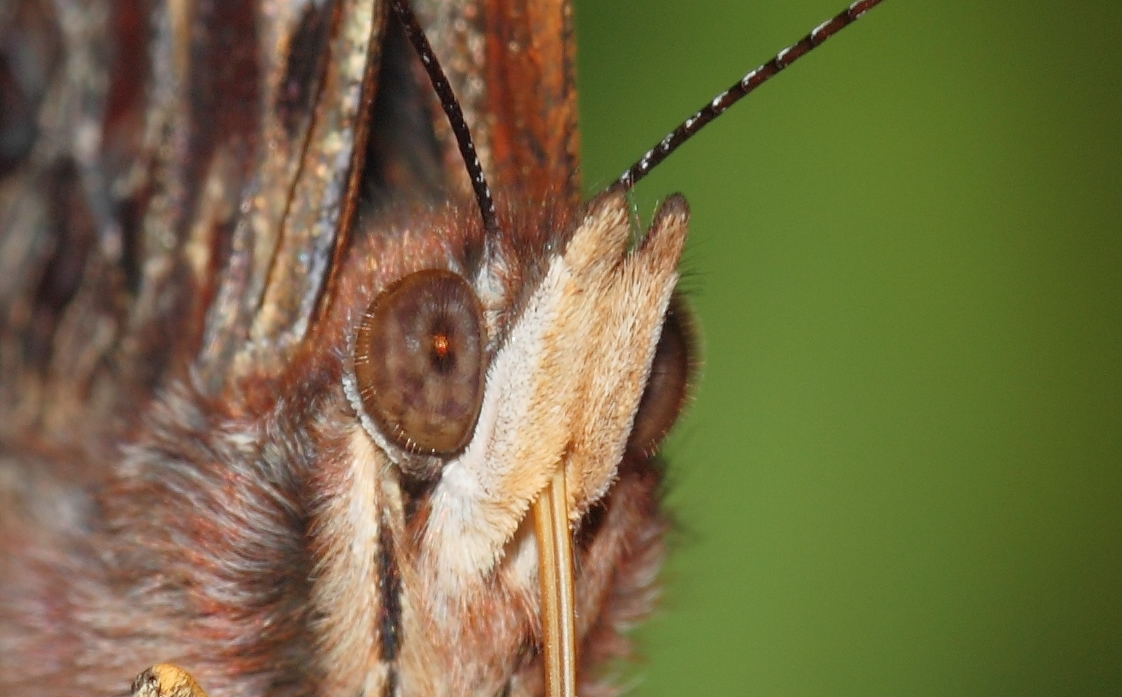
- The primary issue with using a flash is the bright spot generated by the flash, especially when shooting subjects that are reflective or shiny on their own. Bugs tend to reflect the flash off their eyes and off their exoskeletons. Using a flash difuser can spread the light out more evenly but still results in brighter spots than shooting without the flash. Unless you're shooting a dead-still subject, the flash is almost a requirement for macro photography. Modern flashes also have built-in options for making the flash brighter or darker. I've gone to both extremes of flash power output in various macro shoots. The more sunlight you have on your subject, the more you can tone down the power output of the flash. The darker the subject (in the shadows or on a cloudy day), the more flash power you'll need. Shutter speed, ISO, and aperture can all be adjusted to get the results you want. If you shoot enough, you'll develop your own preferences and will be surprised at how closely you can guess the correct settings from the very first shot. Sometimes you only get one chance. The butterfly face example shows the diffused flash reflected as an orange spot in the middle of this butterfly's eye. You can see how quickly the butterfly goes out of focus. Even at f/13, there's very little room for error as the depth of field is very, very shallow. in this case around 1/3 inch or less.
- Standard shooting: Many manufacturers claim their macro lens can be shot as a standard lens as well. And, for the most part, that is true. What you will tend to find, however, is that they don't really perform well as a standard lens. With the very short minimum focusing distance of inches, normal shooting makes subjects considerably smaller as they are generally many feet away. As you get farther from the minimum focusing distance, you begin to reduce the effective ratio of subject size to sensor size and quickly lose ground to the standard lens even of the same mm rating. The macro lenses tend to be "darker" than the standard lens of the same aperture rating, again likely due to the lens construction that provides that super magnification at close range. The other thing I've discovered, at least with the 105mm lens, is that chromatic abberation is a really significant issue when shooting as a standard lens especially when the subject is backlit or is dark against a bright background.
< Previous | Next >