Photography Basics
List of Terms
Extension Tubes and lens adapters:
Extension tubes: Extension tubes attach to the lens at the "small end" and then to the camera. They are essentially hollow metal tubes the push the image sensor farther from the lens's focusing plane. That means your minimum focus distance decreases. Instead of having to be 20 feet from my subject, using the 800mm lens, I can get to 15 or 16 feet. Instead of a 0.14x ration (subject size versus sensor size), that can be increased to 0.16x and 0.19x by using extension tubes to lower the minimum focusing distance. But, that also means that, at the original focus distance of 20 feet, the image would be even smaller than 0.14x. While the extension tubes are hollow, they still reduce the light reaching the image sensor though not nearly as signficantly as magnification adapters which contain additional lenses or glass elements.
Lens adapters: Going in the opposite direction from extension tubes, where you can get closer to your subject to gain magnification, lens adapters can be added to increase the magnification or focal length of that 800mm beast to 1120mm or 1600mm using a 1.4x or 2.0x adapter. The tradeoffs are focus sharpness and aperture. The 1.4x adapter changes the aperture from f/5.6 to f/8.0 while the 2x adapter changes the aperture to f/11 (half the light of the clean lens.) The 1.4x adapter can still provide a nicely crisp image while only losing a half stop of light and the autofocus system will likely still work though a bit more slowly. On the f/2.8 lens, the aperture drops to f/4. On the 800mm lens, with the 1.4x extender, the camera's autofocus system now works with only the center focus point. If I attach the 2.0x converter, instead of the 1.4x, the aperture drops from f/5.6 to f/11 and I have to manually focus. None of the autofocus points works any longer.
That is another point of consideration when choosing the camera and lens combinations you want to use. Not all cameras are equal when it comes to their autofocus systems especially with regard to the aperture at which the autofocus stops working. But, another distinction needs to be made here about aperture with regard to lens adapters. There's a difference between lens aperture and aperture setting in the camera. I'll continue using the 800mm lens as the example. If I shoot my f/5.6 lens at f/8 in the camera, the effective light reaching the image sensor is roughly the same as if the lens itself were actually an f/8 lens. With good lighting, I could change the camera aperture setting to f/11 or f/16, and all the focus points would still work. I'm simply changing the camera's aperture setting to affect lighting and depth of field. But, I can't change the camera's aperture beyond f/5.6, say to f/4 or to f/2.8 because the lens limit is f/5.6. Adding an adapter, like the 1.4x or 2.0x mentioned above changes the physical aperture capability of the lens to f/8 or f/11. As the physical aperturer changes, the camera loses the ability to autofocus with all focus points. Some newer camera models have claimed autofocus capability "down" to f/22, which is quite spectacular considering my sports camera won't autofocus beyond f/8 lens aperture with even the center focus point (the most sensitive in that camera.) So, if you expect to make use of lens adapters for additional magnification, you should determine the lens aperture in combination with the adapter and then ensure the camera is able to autofocus "down" to at least that aperture with some or all of its autofocus points.
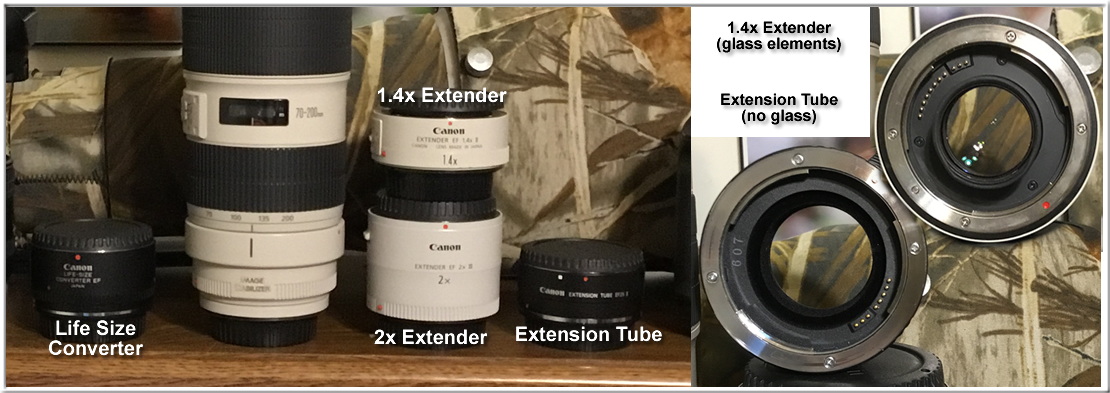
The life size converter is a specialty adapter meant for a specific macro lens. The macro lens was only a 0.5x subject size to sensor size. The life size adapter was essentially a 2.x extender to make that macro lens a true macro of 1x subject size to sensor size. I found it actually worked with a couple of other lenses as well so I kept it when I sold that macro lens.
< Previous | List of terms on Page 2 <<<<<