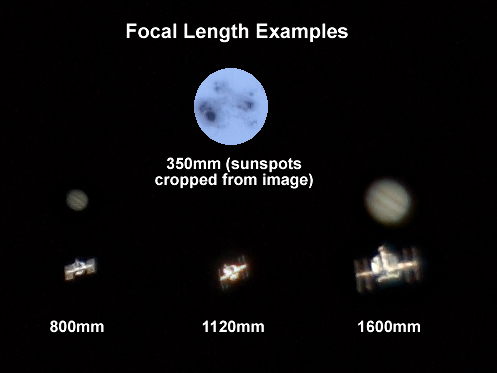
Magnification (x-factor) and focal length (mm rating): When looking for camera lenses, despite any other rating or factor, such as cost, mount type, manufacturer, or compatibility issues, the magnification factor plays a major role in a lens purchase. The higher the mm number, the greater the lens magnification though that mm rating specifies the focal length of the lens. Magnification is based upon the standard of 50mm being a 1x magnification or what I clearly see with my eyes. So, a lens designated as 100mm would provide twice the magnification level of a 50mm lens shot at the same distance on the same camera.
So, why choose a 400mm lens over a 50mm lens or vice-versa? There are many reasons for choosing one lens over another.
1. What subjects do you intend to photograph? If your subjects will likely be people at close range or landscapes at great range, then the shorter focal length lenses will do well for you. If you intend to shoot wildlife at longer range than you would people, you'll typically need a longer focal length lens in the 200-400mm range or greater. But you better have a signficant budget set aside for these longer lenses as they become quite pricey. Opting for a smaller aperture version of the same lens will save you a significant amount of money. But the trade-off in aperture is reduced light and sometimes reduced clarity or detail sharpness. As you move beyond f/4, you may also find your autofocus can become significantly slower than the same focal length lens with a larger aperture (f/5.6 or f/6.5 or f/8 will tend to focus more slowly than an f/2.8 or an f/4 aperture lens.)
2. What are your cost limitations? Lower magnification lenses tend to be cheaper than larger magnification lenses of the same f-stop rating (f/2.8, f/4, etc.) Faster lenses, f/1.4, f/2.0, f/2.8 tend to be significantly more expensive than their slower counter parts (f/4, f/5.6, f/8) for the same focal length. Specialty lenses can throw a wrench into this generalization however. Fisheye, macro, and tilt-shift lenses cannot be directly compared to these standard lenses when it comes to cost. Specialty lenses seem to have their own pricing scheme.
3. In what environments are you likely to find yourself when shooting? Will you be shooting in a crowd, crammed into a narrow boardwalk with thousands of other birders, or in a large crowd at a concert? Will you be in a studio setting shooting at short ranges where a short focal length lens will suffice? Or, will you be out in the weather shooting at long ranges? Longer focal length lenses generally have special weather-sealing applied to them as they are used primarily for outdoor photography, such as sports and wildlife, where you may face weather extremes and moisture issues you don't face indoors.
4. Do you primarily intend to shoot still life or action? If shooting still life subjects, whether household items or landscapes, shorter focal length lenses fit the bill. Not only do you see more of your subjects, but you also get greater depth of field with the shorter focal length than you do with long focal lenght lenses. When shooting action shots, whether wildlife, sports, or aircraft, you will tend to need a longer focal length for the magnification. Shooting an airshow or a flying eagle with a 50mm lens won't show you much detail of the fighter jet or the eagle. Sure they will be easy to track but you'll see more sky than you will plane or bird.
5. Do you have any physical limitations where you can't handle the heavier lenses in the telephoto or super-telephoto range? Wide angle lenses, those below 50mm, are suitable for shooting people and scenery, or subjects that don't require any significant magnification. They also tend to be lighter weight, are handled much more easily, and can be shot handheld at slower speeds than larger magnification or longer focal length lenses. The Canon 800mm lens weighs in at 9.9 pounds. That's just the lens weight. The Nikon16-80mm zoom lens weighs in at a paltry 17 ounces.
Focal Length/Magnification Samples: Cropped portion of a filtered image of the sun during a peak in sunspot activity (350mm focal length); 800mm and 1600mm samples of Jupiter; 800mm, 1120mm, and 1600mm samples of the Inernational Space Station. Small subjects at great distance require extreme focal lengths to capture any detail whatsoever. Large object at great distance, such as the sun, can be captured with much shorter focal length lenses.
The link below plays an original 1920x1080 video of the moon, downsized to 1280x720 to reduce the file size, showing extreme focal length of approximately 5,600mm achieved by attaching a Canon video camera, that uses 3x 1/3" sensors, to an 800mm lens. The effect is a 7x magnification or increase of the original lens's focal length. With greater magnification, especially shooting through the atmosphere, comes greater distortion. That distortion appears as shimmering, especially along the edges of the moon. That is also much of the cause of the lack of detail in the craters. Additional detail loss results from combining two very different optical systems. Another feature of great magnification is the speed at which the moon passes through the field of view. The lens is repositioned part way through the video to show the moon's edge again. Chromatic aberration is also present in the orangish glow along the lower edges in the latter portion of the video. The link opens in a new tab or browser window.
MoonMagnify.mp4NOTE: The following was borrowed from a Nikon web page describing focal length: Lens focal length tells us the angle of view—how much of the scene will be captured—and the magnification—how large individual elements will be. The longer the focal length, the narrower the angle of view and the higher the magnification. The shorter the focal length, the wider the angle of view and the lower the magnification.