Photography Basics
List of Terms
Wide-angle and Telephoto lenses are standard designations for general magnification levels or focal lengths assigned to a given lens. Both lens types can be of a fixed focal length (a single mm rating) or a zoom type (multiple mm ratings.) Wide-angle lenses are generally below 50mm down to about 10-15mm. Below 15mm, your image will bend significantly. Lenses below 10mm are considered "fisheye" lenses and can produce an almost round image of the lens's surroundings. Image bending can actually begin being noticed below 50mm and becomes more pronounced or obvious the farther you move down in the mm rating or focal length. Telephoto lenses run from about 70mm up to 200mm in focal length.
Super-telephoto lens: Generally anything above 200mm; available up to 800mm from major manufacturers such as Nikon and Canon. With 50mm considered a normal human eye perspective or magnification, the 200mm lens would be a 4x and an 800mm lens would be a 16x magnfication level compared to the human eye. These x-factors should not be confused with the 20x or 30x ratings you see on point and shoot cameras or cameras with non-removeable lenses. Those x-ratings are the maximum mm rating versus the lowest mm rating. For example, a fixed-lens camera with a 24mm widest angle rating and a 480mm maximum rating would show a 20x optical zoom designation. But a true 20x magnification would be 1000mm (20x 50mm) in the standard DSLR market. While 24-480mm zoom would be awesome, it's not a true magnification designation. It's a zoom level rating from shortest to longest focal length.
- Prime lenses have a single mm rating. Prime lenses in the 400-800mm range are typically used for shooting subjects at greater ranges or subjects that require greater magnification, especially at significant distance, which would be almost unnoticeable with a 50mm or smaller lens. Sports, wildlife, and moon photography are typical subject matter for these larger lenses (typically referred to as telephoto or super-telephoto lenses.)
- Zoom lenses provide a range of magnification and can be considered wide-angle zoom or telephoto/super-telephoto zoom. Specialty lenses can encompass zoom ranges from wide-angle to telephoto or even super-telephoto. 30-300mm would be considered a wide-angle to super-telephoto zoom lens. The 70-200mm would be a telephoto zoom lens and the 100-400mm a telephoto-super-telephoto zoom lens. Mostly manufacturers determine what they call their lenses at various mm ratings.
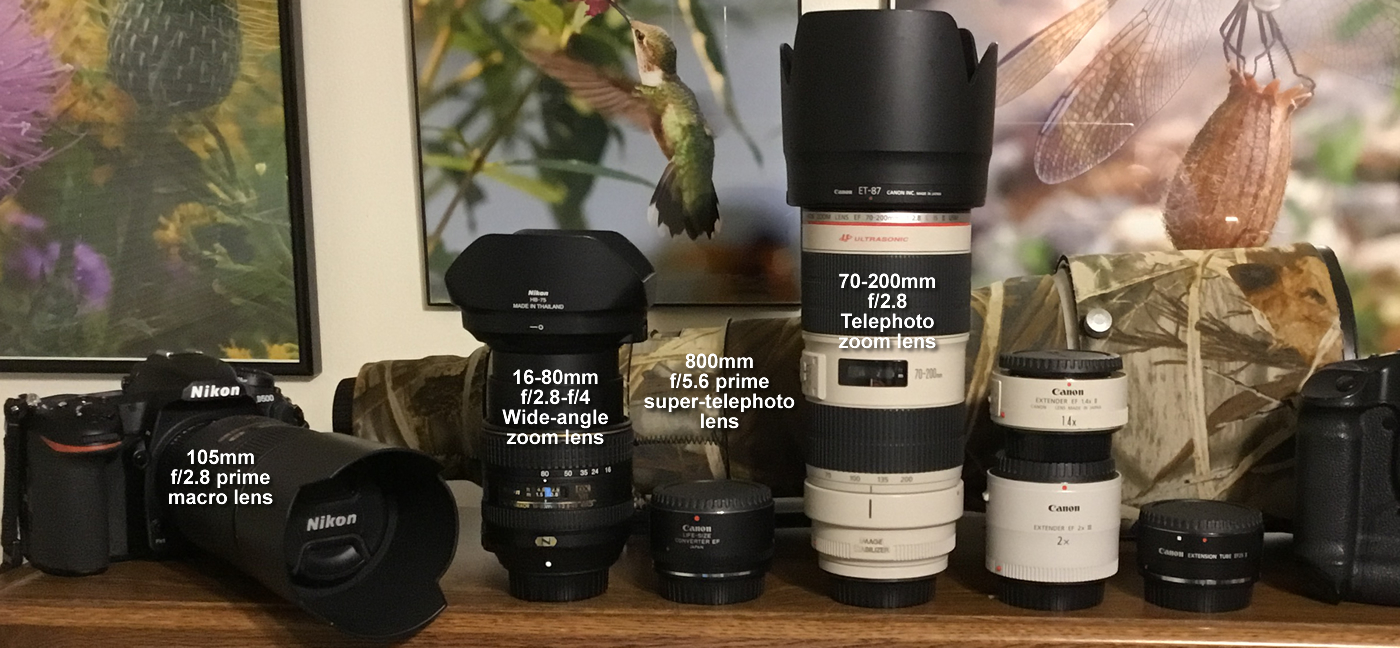
From left to right, the image contains examples of a prime macro lens, a wide-angle zoom lens where the zoom extends the lens to a longer length and has two aperture ratings, the 800mm prime super-telephoto lens (in the back), and the 70-200mm fixed aperture, telephoto lens where the zoom occurs internally so there's no extension in length. That is how a fixed f/2.8 aperture is maintained. If the lens extended in length, the aperture would change.
< Previous | Next >