ISO: International Standards Organization. That's exactly what ISO stands for. But, you may be asking, what that has to do with my camera and how that affects my image exposure. Back in the era of film photography, film cartridges were rated by the ISO with various numbers, also referred to as film speed or film ISO. A roll of ISO 100 or ISO 64 film required a lot of light (a sunny day or bright lights) for proper exposure. A film speed of ISO 200, 400, or 800, required only 1/2, 1/4th, or 1/8th of the light for same exposure as the ISO 100 film required. So, by using an ISO 200 film, you could use the same shutter speed and aperture as you used with an ISO 100 film and your image would be twice as bright. You didn't change your shutter and aperture, but you loaded a roll of ISO 200 film and got a much brighter picture. But you ruined the rest of your ISO 100 film roll.
Digital photography overcame those problems by allowing you to change your "camera's" ISO setting from one picture to the next. If you shot a scene at ISO 100, 1/60th of a second, and an aperture of f/8, and found the image was too dark, but you wanted the same shutter speed and depth of field (aperture f/8), you could simply press the ISO button and roll a dial to select a different ISO number, say ISO 400, take another shot, and the resulting image would be 4x brighter (2x brighter at ISO 200.)
So, why not always shoot at ISO 64,000 or 128,000 and get crazy shutter speeds and depth of field? The answer is exactly the same as it would have been for shooting standard film rolls at those crazy ISOs, except that film barely managed to reach ISO 1000. And that was considered to be used only for very dark settings or night-time photograpy and long exposures (long shutter speeds, sometimes measured in multiple seconds rather than fractions of a second.)
The ISO issue is film grain or digital noise, especially in darker areas of the image. Film grain refers to the actual composition of photographic film. The film was covered in light-sensitive materials that had very small "grains" at lower ISO numbers, and larger grains as the ISO number increased. Smaller grains were less light sensitive so required brighter settings for proper exposure. Larger grains were more sensitive to light but produced more "spotty" or more grainy images. The same applies to ISO settings in digital photograpy. The higher the ISO setting, the grainer the image becomes. But with continuous advancements in digital signal processing, the "grainy" affect is less and less prevalent or noticeable, though it is almost always a smoother image at lower ISO settings. You can compare this to looking at a mosaic from a distance of 100 feet. The overall picture would look pretty good if it were large enough to see at that range. As you get closer to the mosaic, the individual tiles become more obvious. At a distance of 10 feet, you might not even see what the overall image is because all you see is a bunch of individual colored tiles, not the image they represent collectively. At 100 feet, you are at ISO 100. At 10 feet, you're at ISO 1000. Not really, but "you get the picture!" When you stop groaning, we can move on.
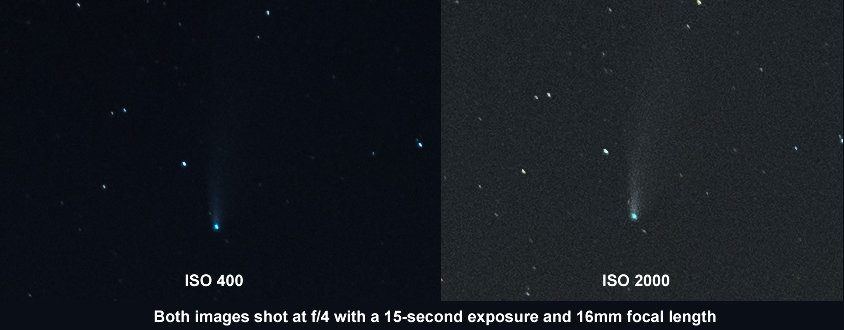
These images of comet NEOWISE show the issue with digital noise or grain that are very apparent when shooting dark subjects or subjects with dark backgrounds or components. While the lens was set at its shortest focal length, 16mm, the camera sensor is an APS-C with a 1.5 crop factor, essentially making the focal length 24mm (16mm * 1.5.) This smaller sensor also adds to the noise factor but, as you can see, at ISO 400, there noise is almost negligible. At ISO 2000, the noise is almost unacceptable.