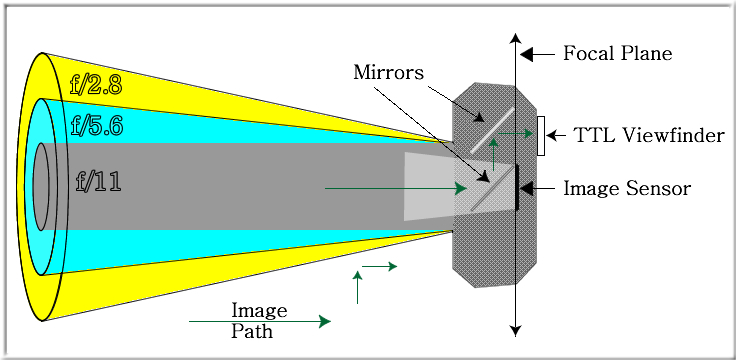
Shutter: The term shutter most specifcally relates to the the covering over the sensor that opens and closes to allow light to reach the sensor and capture the image. In typical digital single-lens reflex (DSLR) cameras, a mirror sits in front of the shutter, between the sensor and the back of the lens (where the lens attaches to the camera.) When the shutter release is pressed, the mirror flips up, out of the way, and the shutter opens momentarily to allow the light to reach the sensor and the image is captured. That is why, when you are taking the photo, you momentarily lose sight of your subject. When the mirror flips up, it no longer reflects the image to the upper mirror. The shutter would sit between the lower mirror (in the below drawing) and the image sensor, would be a 2-piece shutter, and would typically open up and down with the exposure time being when both shutters (curtains) are open.
In mirrorless cameras, there is no mirror to reflect the image to the camera viewfinder. There are also different "shutter" types in mirrorless cameras. You may find a standard shutter as described above, a single shutter rather than a two-part, and an electronic shutter which essentially just charges the sensor to capture the image (as in cell phone cameras.) Without a mirror to reflect the image to the viewfinder, pressing the shutter release just opens the "curtain" to allow the light to reach the sensor or charges the sensor to capture the image. The difference is that, with mirrorless cameras, the image you see through the viewfinder is sent to a small screen electronically and you are looking at that screen image, not the actual image coming through the lens (referred to as a Through-The-Lens (TTL) viewfinder.) There are advantages and disadvantages to each type of viewfinder. We might get to those much later in these tutorials.
When you hear the term shutter speed, that refers to the duration that the shutter is open to allow light to reach the sensor or the momentary high charge of the mirrorless camera sensor to capture the image. A shutter speed of 1/100th of a second, means that the shutter is fully open for only 1/100th of a second or the sensor is charged for 1/100th of a second. That's all the time that the maximum amount of light is able to provide an image to the sensor. Manipulating the camera's shutter speed changes the exposure or brightness of your image. If your image is too bright, use a faster shutter speed. If it's too dark, use a slower shutter speed. The same applies to the aperture settings except that you can't make the aperture more open than the lens's maximum aperture. So you have to manipulate the shutter speed and the aperture to get the exposure you desire. Well, there's also third setting you can change to affect the exposure without changing the aperture or shutter speed. That is the next term, ISO.