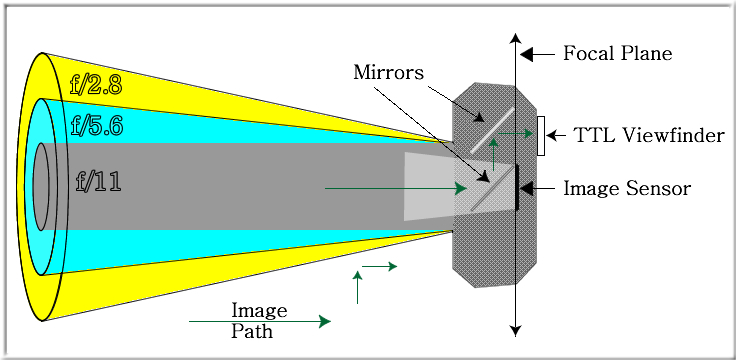
Aperture: Aperture refers to the opening of the lens that allows light to pass through to the imaging sensor or film bu tis also tied directly to the focal length of the lens. The more light that reaches your imaging sensor, the brighter the captured image will be. The maximum opening or light-gathering capability of any lens is typically stated as a fraction of a whole and is designated as an f-stop, such as f/2.8, f/4, f/5.6, f/8. Since this expression is a fraction, where the f could be considered to be a 1, a lens rated as an f/2.8 aperture (called a maximum aperture) means that only 1/2.8 of all the light getting through the front of the lens actually reaches the imaging sensor. An f/4 lens allows, at most, only 1/4th of the light to reach the sensor. As the right side of the f/# gets larger, the amount of light reaching the sensor becomes less. An f/8 lens allows only half of the light to reach the sensor as an f/4 lens allows. The longer the lens barrel, the less light reaches your camera's sensor, based on an unchanging front lens diameter.
This image is a simple drawing, not to any specific scale, but it gives a basic visual perspective on the aperture issue. The drawing assumes the same focal length for the lens for all apertures. Let's assume this is a 400mm lens. The 400mm, f/2.8 lens would have a very large diameter lens to allow a lot of light into the lens tube. As the light passes through the lens tube, a series of additional lenses provides image magnification and focusing such that, in the end, the image is transformed to focus the image exactly where the light hits the focal plane of the image sensor where it is captured. The 400mm f/5.6 lens would do exactly the same thing except only half the amount of light ever reaches the lens tube and subsesquently the image sensor. Move onto the 400mm, f/11 lens. Now only half the light of the f/5.6 lens makes it to the sensor but the lens is much smaller in diameter, is much lighter because the glass lenses are much smaller, and it's vey cheap compared to the f/5.6, which is, in turn, much cheaper than the f/2.8. This drawing will be employed in other sections for explaining other components.
Some lenses have multiple f/# designations. These are zoom lenses rather than "prime" lenses. Prime lenses have a fixed magnification level stated in milimeters (mm.) Zoom lenses have two mm or magnification ratings. They can also have a single aperture rating or two aperture ratings, one at either extreme of the zoom range. A typical pair of examples is a 200mm fixed/prime lens with a single aperture rating of f/2.8. That indicates the maximum opening of the lens allows only 1/2.8 (slight more than 1/3rd) of the available light to reach the sensor. Manipulating the camera setting can allow less light to reach the sensor by changing the camera's aperture setting. But the camera cannot make the aperture larger to allow in more light. The lens is physically limited to the rated f/2.8 aperture. A zoom lens with a constant aperture remains the same length throughout the zoom range as the focal length change occurs inside the lens tube.
A typical zoom lens is 70-200mm or 24-105mm. Each of these could be rated as f/2.8 or f/4, meaning that the maximum opening of the lens doesn't change as you change the zoom or magnification level. If a lens were rated with two f/#'s, such as a 100-400mm f/4 - f/5.6 lens, that would indicate that, at the 100mm zoom level, the aperture or opening would allow in only 1/4th of the available light. At the 400mm magnification or zoom level, the opening would change to allow in only 1/5.6th of the light. The opening, or aperture, doesn't suddenly change but does so somewhere along the way as you zoom the lens from one end to the other. These lenses "typically" become longer as you zoom to the higher magnification level, which is why the aperture changes. The opening remains the same but the light must now traverl farther through the lengthening lens tube, which reduced the light reaching the sensor.
The other important feature of the aperture setting/rating is that, the higher the right-side of the f/# rating, the greater the depth of field or area that is in focus. So, not only does aperture affect the amount of light reaching the sensor, it also affects the range of your image that is in what is called acceptable focus or depth of field. Changing the aperture, using the camera aperture control, from f/2.8 to f/5.6, not only cuts the light in half but it increases the amount of area of your image that will be in focus. The out of focus area, typically what is behind the focused area, is called bokeh (BOW-keh with a short e sound and BOW like in archery not like the front of a boat!)